
🌍 Flora and Fauna of Mount Kilimanjaro — A Complete Guide
Mount Kilimanjaro, rising majestically from the plains of northern Tanzania to 5,895 m (19,341 ft), isn’t just Africa’s highest peak — it’s a living ecological tapestry. Here, five distinct ecological zones stack atop one another like a vertical garden, each with its own climate, plants, animals, and ecological rhythms. As you ascend, the landscape shifts dramatically, from lush tropical forest to stark alpine desert and ice-capped summit.
This content explores Kilimanjaro’s flora and fauna in depth, offering both scientific context and vivid, reader-friendly descriptions.
🌿 Introduction: The Mountain as a “Botanical Staircase”
Mount Kilimanjaro is often described as a “botanical staircase” — a single mountain that encapsulates a progression of ecosystems normally spread across thousands of kilometers. Its slopes host an extraordinary diversity of plant and animal life, shaped by altitude, rainfall, temperature, and soil. In total, scientists have recorded over 2,500 plant species on Kilimanjaro, many of them endemic, along with hundreds of bird and mammal species.
The dramatic changes in climate and terrain make Kilimanjaro a natural laboratory for studying adaptation and biodiversity.
🌱 Part I — Flora: Vegetation Across Kilimanjaro’s Zones
🏡 1. Cultivated Footslopes (800 – 1,800 m)
At the base of the mountain, before the wild landscapes begin, lies a human-dominated zone where agriculture and natural vegetation intermingle. This area supports crops like banana, coffee, maize, and yams, cultivated by local communities living in volcanic soils rich in nutrients.
Key Features
Agricultural landscapes blended with woodland patches.
Traditional agroforestry systems such as the Chagga home gardens.
Rich soils support a mix of cultivated and wild plant species.
🌳 2. Montane Rainforest Zone (1,800 – 2,800 m)
The rainforest zone is the biological heart of Kilimanjaro, drenched in moisture carried from the Indian Ocean. This zone is often swathed in clouds and mist, creating a humid, lush environment brimming with life.
🏔️ 3. Heather and Moorland Zone (2,800 – 4,000 m)
Above the dense forest, the rainforest gives way to a cool, open heath and moorland — a surreal landscape of shrubs, grasses, and other hardy plants adapted to cool temperatures and steady mist.
Dominant Plants
Heather shrubs (Erica spp.) that blanket slopes in pinks, purples, and whites.
Giant groundsels (Dendrosenecio kilimanjari): towering plants that can exceed 5–9 meters, with thick trunks and rosettes of leaves that help them endure frost and drought.
Lobelias (Lobelia deckenii): striking, rosette-forming plants adapted to cold nights.
Protea kilimandscharica and Kniphofia thomsonii add vivid flowers to the moorland
Tussock grasses and heaths provide groundcover in patchy terrain.
Adaptations
Plants here show remarkable strategies:
Waxy leaves and dense hairs to reduce evaporation.
Rosette structures that trap warm air.
Water storage tissues for dry periods.
The moorlands are especially breathtaking at dawn, often shrouded in mist, with sunlight filtering through strange and beautiful vegetation.
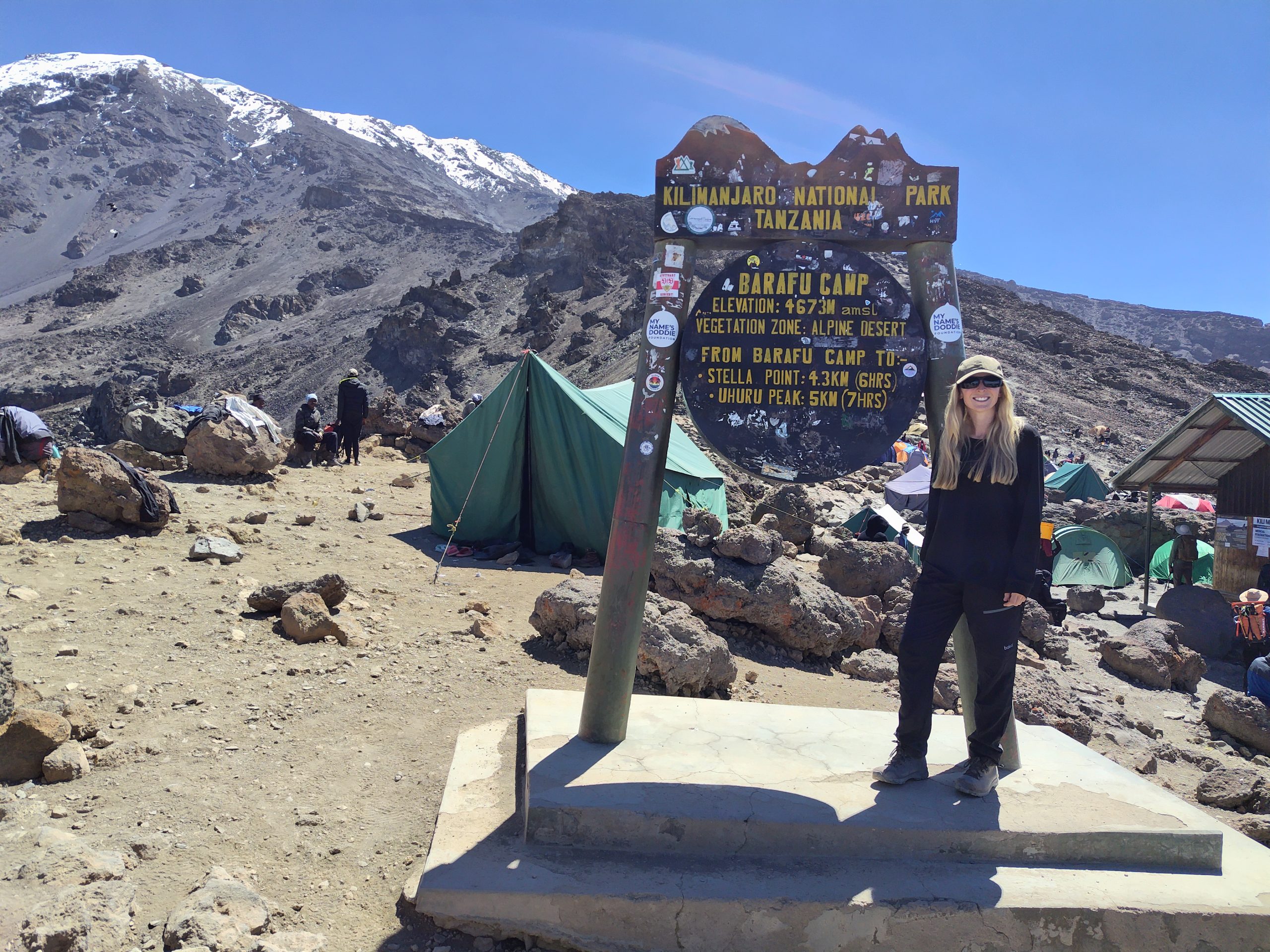
🏜️ 4. Alpine Desert Zone (4,000 – 5,000 m)
Here, the environment becomes harsh and inhospitable — intense sun by day, freezing at night, with very little rainfall. Yet some plants persist, small but tenacious.
Flora of the Alpine Zone
Hardy lichens and mosses cling to rocks.
Everlasting flowers (Helichrysum newii and others).
Sparse tussock grasses and dwarf shrubs.
Despite appearances, this “desert” supports species finely tuned to extreme conditions, often lying dormant for long periods between moisture events.
❄️ 5. Arctic Summit Zone (Above 5,000 m)
At the highest elevations, plant life essentially vanishes. Only microbial algae and the hardiest lichens manage to survive where temperatures remain below freezing and solar radiation is intense.�
kilimanjaropark.org
🐾 Part II — Fauna: Wildlife of Kilimanjaro
Kilimanjaro’s wildlife changes with altitude just as its vegetation does. From large mammals in the forests to specialized birds and hardy rodents at higher elevations, the mountain hosts a remarkable array of animal life.
🐘 1. Mammals
🦍 Montane Forest Mammals
The lower forest is the richest in large mammal diversity. Although big game like buffalo and elephants are rarely seen by climbers (many large herbivores are more common in adjacent savanna areas), they do roam the forest fringes.
Notable Mammals
African Elephant (Loxodonta africana): occasionally into forest from lowland plains.
Cape Buffalo (Syncerus caffer): near water sources.
Black-and-White Colobus Monkey (Colobus guereza caudatus).
Blue Monkey (Cercopithecus mitis).
Bushbuck and duikers — small antelopes adapted to dense vegetation.
Tree hyrax: small nocturnal mammals with haunting calls at night.
Leopard (Panthera pardus): elusive predator found occasionally on forest and moorland edges.
Rodents and shrews become more common at higher altitudes where larger mammals are absent.
🐦 2. Birds
Kilimanjaro’s birdlife is rich and varied due to the range of habitats. From vibrant forest species to highland specialists, birdwatchers find plenty to explore.
Forest Birds
Hartlaub’s turaco — a colorful resident of the rainforest canopy.
Silvery-cheeked hornbill — large forest bird with booming calls.
White-necked raven — common around campsites at higher elevations.
Various robins, bulbuls, and flycatchers in the lower zones.
High-Altitude Birds
Scarlet-tufted malachite sunbird — vivid and adapted to moorland flowers.
Alpine chat and alpine swift near moorland and alpine zones.
Bearded vulture and steppe eagle sometimes seen soaring above high ridges.
🦎 3. Reptiles and Amphibians
Reptiles and amphibians are mostly confined to the warmer, humid lower slopes.
Examples
Jackson’s chameleon — a colorful climber.
Various skinks and geckos in forest clearings.
Tree frogs near streams, especially during the wet season.
Recent observations suggest high-altitude frogs may inhabit elevations once thought too cold, illustrating how our understanding of mountain wildlife continues to evolve.
🪲 4. Invertebrates
Insects — from butterflies to beetles — flourish in the forests and moorlands, serving as pollinators and food sources for other wildlife. Some butterfly species found here are endemic, adding to Kilimanjaro’s unique biodiversity.
🌎 Adaptations to Altitude
Life on Kilimanjaro isn’t easy. Whether plant or animal, species here show remarkable adaptations:
🌿 Plant Strategies
Rosette structures (like in lobelias) trap warmth.
Insulating hairs and water storage in giant groundsel.
Low-lying growth to resist wind and conserve heat.
🐾 Animal Adaptation
Smaller body sizes in high altitudes conserve energy.
Hibernation or nocturnal habits in response to temperature extremes.
Birds with efficient respiratory systems thrive where oxygen is thin.
🌱 Conservation and Threats
Though Kilimanjaro is protected as a national park, its ecosystems face pressures:
Climate change is reducing ice fields and shifting vegetation zones upslope.
Deforestation at lower elevations threatens habitats and water catchments.
Human-wildlife conflict arises on the cultivated footslopes.
Ongoing research and conservation efforts strive to balance ecotourism, local livelihoods, and biodiversity protection.
🌟 Conclusion
Mount Kilimanjaro’s flora and fauna reflect the mountain’s ecological wonder. From lush rainforest giants to the hardy, surreal plants of the moorlands and sparse life near the summit, every elevation holds unique species and stories. Whether you’re a climber, birdwatcher, botanist, or nature lover, Kilimanjaro offers a vertical journey through life’s astonishing diversity — preserved through adaptation, molded by climate, and cherished by science and culture alike.